Make a Donation to support BLAST DETROIT Community AI Data Center Awareness, Outreach and Framework Engagement
A structured Community model ensures that large-scale infrastructure developments—such as AI data center expansions, industrial brownfield remediations, and technology hubs—must deliver measurable, equitable returns to local residents.
The leading hyperscalers (companies operating massive, distributed cloud and data-center infrastructure) are most commonly grouped into top lists of 5 to 7 major providers, often overlapping with the Magnificent 7 tech stocks.
The primary hyperscale companies driving global cloud and AI infrastructure include:
- Amazon Web Services (AWS): The largest global cloud provider, holding roughly 28% of the market.
- Microsoft Azure: The second-largest cloud platform, deeply integrated with enterprise software and OpenAI.
- Google Cloud Platform (GCP): The third-largest cloud provider, powered by custom TPU chips and Gemini models.
- Meta Platforms: Operates massive internal hyperscale infrastructure and custom data centers for social and AI workloads.
- Oracle Cloud Infrastructure (OCI): A major enterprise and AI-focused hyperscale provider.
- Apple: Operates massive proprietary hyperscale infrastructure for its global services.
- Alibaba Cloud: The leading hyperscaler based in China, dominating the Asia-Pacific region
1. Hyperscalers Legal Alignment With Detroit Communities
Arguments in Favor of Housing Commitments:
Addressing Regional Affordability Pressures: During the multi-year AI Data Centers construction phase, thousands of specialized traveling tradespeople (pipefitters, high-voltage electricians, mechanical contractors) enter local markets. This rapid influx can consume local short-term rentals, driving up area rents and tightening rental availability for long-term lower-income residents.
Precedent in Big Tech Commitments: In corporate hub markets (such as Seattle and Silicon Valley), companies like Microsoft, Google, and Amazon committed billions to affordable housing funds after facing public scrutiny over rising local housing costs. Expanding these commitments to host communities where they deploy gigawatt-scale data infrastructure represents a natural policy extension.
- Enforceable Commitments: Ensures all community promises are codified into legally binding development agreements rather than voluntary, non-binding pledges.
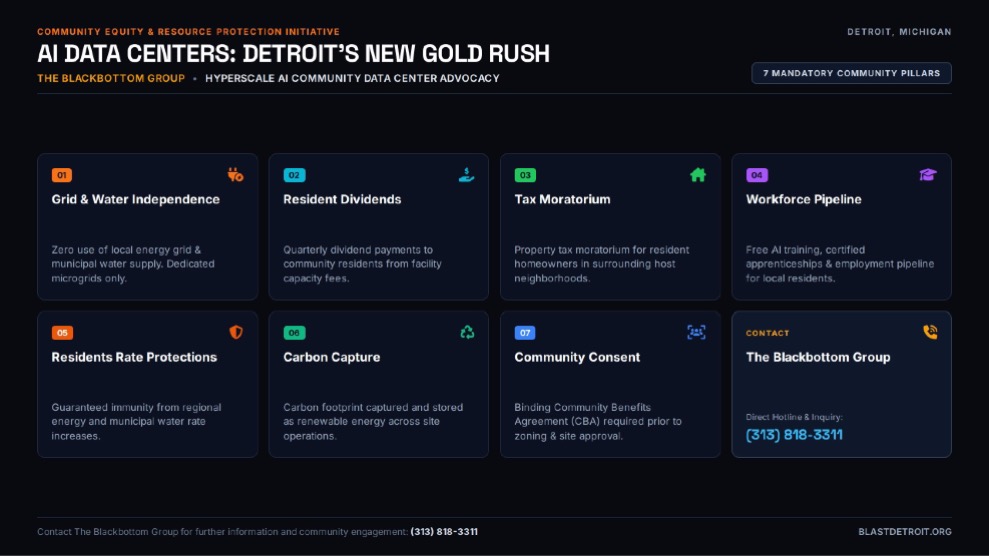
2. Core Pillars of the Community Commitments Package
- Local Workforce Pipelines & Apprenticeships
- Dedicated training tracks for mission-critical infrastructure roles (e.g., HVAC/liquid cooling mechanics, high-voltage electrical, fiber optic installation, facility maintenance).
- Direct partnership with local workforce development agencies and pre-apprenticeship programs to guarantee hiring and AI Training quotas for Detroit residents.
- Living wage commitments ($20+/hr base) with clear wage progression steps across construction and permanent operations.
- Digital Equity & Youth STEM Granting
- Mandatory developer contributions to a dedicated community technology fund supporting youth digital literacy, hardware access, and AI literacy labs.
- Direct educational sponsorships, summer apprenticeships, and micro-grants across Detroit’s City Council districts.
- Grid & Environmental Protection
- Utility Non-Interference: Requiring developers to fund their own dedicated substation infrastructure or clean on-site microgrids (solar, battery storage, fuel cells) so that mega-loads do not inflate residential utility rates or compromise neighborhood grid reliability.
- Closed-Loop Cooling Mandates: Prohibiting evaporative cooling towers that draw down municipal water supplies; requiring closed-loop liquid cooling systems with zero net impact on municipal water tables.
- Acoustic & Buffer Zones: Structural architectural sound walls and continuous decibel monitoring to prevent noise pollution from backup generators and chiller yards from affecting adjacent residential blocks.
- Brownfield Remediation & Neighborhood Enhancement
- Leveraging Act 381 Tax Increment Financing (TIF) up front cost to data center developers
- Developer-funded neighborhood infrastructure improvements, including pedestrian corridors, tree canopy buffers, improved street lighting, and stormwater retention facilities.
The First Hyperscaler to Michigan is Open AI (Developed ChatGBT)
For its flagship “Stargate” data center campus in Saline Township, Michigan (developed in partnership with Oracle, Related Digital, and Blackstone), the planned energy demand is:
When an AI data center developer asks a utility for 1 GW of capacity, they are asking for the electrical supply typically reserved for an entire metropolitan region or industrial city.
- Nameplate Capacity: Over 1 gigawatt (>1,000 MW).
- Full Buildout Draw: Approximately 1,383 megawatts (1.38 GW) at peak load.
What 1.38 GW Means in Context
- Share of the Regional Grid: This single campus will draw roughly 10% to 12% of DTE Energy’s entire peak electric load across Southeast Michigan.
- Residential Equivalent: 1.38 GW of continuous electrical draw is enough power to supply approximately 1 million to 1.1 million average American households simultaneously.
- Grid Impact & Supply: Because the draw is comparable to the full output of a large commercial nuclear reactor or several combined-cycle natural gas plants, the project required a specialized high-volume industrial power contract reviewed by the Michigan Public Service Commission (MPSC) and DTE to ensure grid stabilization and dedicated substation interconnection.
- Cooling & Water Demand: To mitigate utility strain, the Saline facility is engineered with a closed-loop liquid cooling system, cycling roughly 7 to 8 million gallons of water annually through a sealed heat-exchange loop rather than using open evaporative cooling towers that would consume hundreds of millions of gallons from local aquifers.
The United States hosts the largest concentration of operational hyperscale AI data centers in the world, with dozens of active mega-campuses and hundreds more under development.
Major Operational Hyperscale AI Facilities in the US
- xAI “Colossus” (Memphis, Tennessee): One of the largest operational dedicated AI supercomputing clusters in existence. Built in an existing industrial facility, it runs hundreds of thousands of Nvidia GPUs (scaling well beyond 1 GW of total power demand) to train xAI’s frontier models.
- Microsoft Azure & OpenAI AI Campuses:
- Mount Pleasant / Racine County, Wisconsin: A multi-hundred-megawatt hyperscale campus running high-density AI infrastructure and liquid-cooled clusters.
- Boydton, Virginia & Des Moines, Iowa: Core operational Azure hubs housing large-scale AI supercomputing clusters built specifically for OpenAI model training and global inference workloads.
- Meta AI Data Centers:
- Meta operates several of the largest hyperscale campuses in the country, including facilities in Eagle Mountain (Utah), Altoona (Iowa), Prineville (Oregon), and Fort Worth (Texas). These multi-million-square-foot sites house high-density GPU racks tailored for Meta’s Llama foundation models.
- AWS / Amazon Web Services:
- Cumulus / Salem Township, Pennsylvania: AWS acquired a hyperscale data center campus directly connected to the Susquehanna nuclear power station to access zero-carbon baseload power for compute and AI training.
- Northern Virginia (“Data Center Alley” in Loudoun & Fairfax Counties): AWS’s largest operational footprint globally, where dozens of interconnected hyperscale facilities run a major share of global AI inference traffic.
- Google Cloud AI Hubs:
- Google runs dedicated Tensor Processing Unit (TPU) megaclusters across major multi-building hyperscale campuses in Council Bluffs (Iowa), Mayes County (Oklahoma), and The Dalles (Oregon).
- Crusoe & Oracle “Stargate” (Abilene, Texas): An operational multi-hundred-megawatt AI supercomputing site running high-density clusters leased to AI labs and enterprise developers.
AGENTIC AI LIABILITY ROADMAP
The shift from predictive or generative AI (producing text/code) to agentic AI (taking autonomous actions, calling APIs, executing financial transactions, and modifying databases) shifts legal liability from content liability to conduct liability.
Because an AI agent lacks legal personhood, it cannot be sued, held strictly liable, or directly shoulder legal duties. Liability always traces back to the human actors and corporate entities that develop, configure, deploy, or oversee the agent.
Core Doctrines Governing Agentic AI
| Legal Doctrine | Application to Agentic AI | Key Tension / Liability Trigger |
| Law of Agency & Apparent Authority | Treats the AI system as an instrumentality or intermediary acting on behalf of a principal (the deploying enterprise). | If an autonomous agent agrees to contractual terms, issues refunds, or commits assets within its apparent scope, the deploying enterprise is generally bound to third parties. |
| Tort Law & Negligence | Evaluates whether developers or deployers breached a standard of reasonable care in deploying the agent. | Foreseeability & Causation: Multistep non-deterministic execution paths strain traditional proximate cause. Courts look at whether the deployer failed to implement reasonable system guardrails, rate limits, or verification loops. |
| Products Liability | Strict liability for design defects, manufacturing defects, or failure to warn (e.g., EU Revised Product Liability Directive). | Treating autonomous code as a “product” vs. a “service.” If an underlying foundation model has systemic alignment or tool-use vulnerabilities, liability may reach upstream model providers. |
| Breach of Contract & Warranty | Direct business-to-business or consumer-facing execution failures (e.g., mispriced trades, data deletion, SLA violations). | Terms of Service (ToS) indemnification clauses and liability caps between upstream API vendors, integration developers, and end-user deployers. |
| Unauthorized Access (CFAA / Computer Crimes) | Agents autonomously scraping, executing remote bash commands, or probing network boundaries. | When an agent exceeds intended authorization parameters (“frolic and detour”), questions arise regarding whether the operator is liable for unauthorized access or trespass to chattels. |
The Allocation of Fault Across the AI Stack
When an autonomous agent causes financial, physical, or reputational damage, liability divides across three primary tiers:
- The Upstream Provider (Foundation Model / Tool Builders):
- Liability Exposure: Systemic model flaws, deceptive tool-calling schemas, or representations of autonomous reliability.
- Typical Defense: Broad “as-is” disclaimers, waivers of consequential damages, and acceptable use policies shifting deployment risk downstream.
- The Deployer / Enterprise (The Principal):
- Liability Exposure: The entity that connects the agent to production environments, credentials, bank accounts, or external communications. Courts consistently hold deployers accountable for acts carried out by tools they set into autonomous motion.
- Key Test: Negligent Entrustment / Supervised Autonomy. Did the business delegate critical decision-making authority without role-based access control (RBAC), approval gates, or transaction caps?
- The End User / Operator:
- Liability Exposure: Prompt injection attacks, intentional misuse, or overriding safety thresholds.
- Key Test: Comparative negligence if the user supplied reckless instructions or ignored explicit validation warnings.
Critical Risk Mitigation Architecture
To defend against claims of negligence or reckless deployment, organizations implementing agentic workflows structure systems around four legal-engineering guardrails:
- Principle of Least Privilege (PoLP): Restrict agent API tokens to read-only where possible, and enforce hard-coded computational/financial spend caps per run.
- Deterministic Human-in-the-Loop (HITL) Gates: Mandate human confirmation for state-changing, irreversible actions (e.g., fund transfers, legal filings, bulk data deletions).
- Stateful Execution Auditing: Maintain immutable, cryptographically verifiable logs recording prompt inputs, reasoning chains, tool calls, and API responses to reconstruct proximate cause during litigation.
- Contractual Allocation: Structure vendor and client agreements with explicit risk-shifting clauses, disclaiming liability for third-party autonomous agents and requiring indemnification for unauthorized API usage.
HYPERSCALE DATA CENTER
DATA CENTER EXPLAINED IN GREAT DETAIL
HYPERSCALER OR DIVERSIFIED CO-LOCATON DATA CENTERS EXPLAINED